A City Built in One Decade: Fitting a Current Viking Into a 1990s Sammamish Cabinet Opening
Why a like-for-like Viking replacement rarely fits a mid-1990s plateau cabinet opening. Viking Repair Sammamish, (425) 610-8986.
The question worth asking first
Ask what year the kitchen was framed, not what year the range was bought. On this plateau the first number predicts the second, and it predicts the awkward part of any replacement.
Most of the plateau went up inside a single decade. The city itself only incorporated on 31 August 1999, with a population of 34,104 recorded in 2000, after ten years of very rapid build-out. That is unusual: most cities are a mixture of eras, and this one is close to a single snapshot.
A kitchen framed in the mid-1990s was framed to mid-1990s built-in dimensions and wired to mid-1990s loads. That is the fact underneath almost every difficult conversation about a Viking on the plateau.
What shortens an appliance life here specifically
Two things, and neither is the appliance’s fault.
The first is the openings. A 1990s 36-inch cooktop cutout, a 1990s 27-inch wall-oven cabinet and a 1990s 24-inch dishwasher opening do not accept current bodies and trim without cabinet modification. When a replacement is squeezed into an opening it does not quite suit, the compromises land on the equipment: reduced side clearance, a unit sitting under thermal load it was not meant to hold, trim forced against a face frame, a rear connection made at an angle that puts strain on a fitting. Those are installation faults that present, months later, as appliance faults.
The second is timing. Because the plateau was finished inside one decade, the ranges, wall ovens, hoods and dishwashers reach the end of their service lives within a few years of each other. Owners in Klahanie and Pine Lake, where the original build-out was densest, tend to meet three separate decisions in three consecutive years. In Sahalee, with larger estate kitchens often carrying a wall oven pair alongside the range, that means several units in the same cohort. Trossachs, built later on the north plateau with panel-ready installs, sits a step behind on the same curve. Mixed-age cities spread this out. This one does not.
Reading the machine you already own
Four faults account for most plateau range calls, and each points somewhere specific.
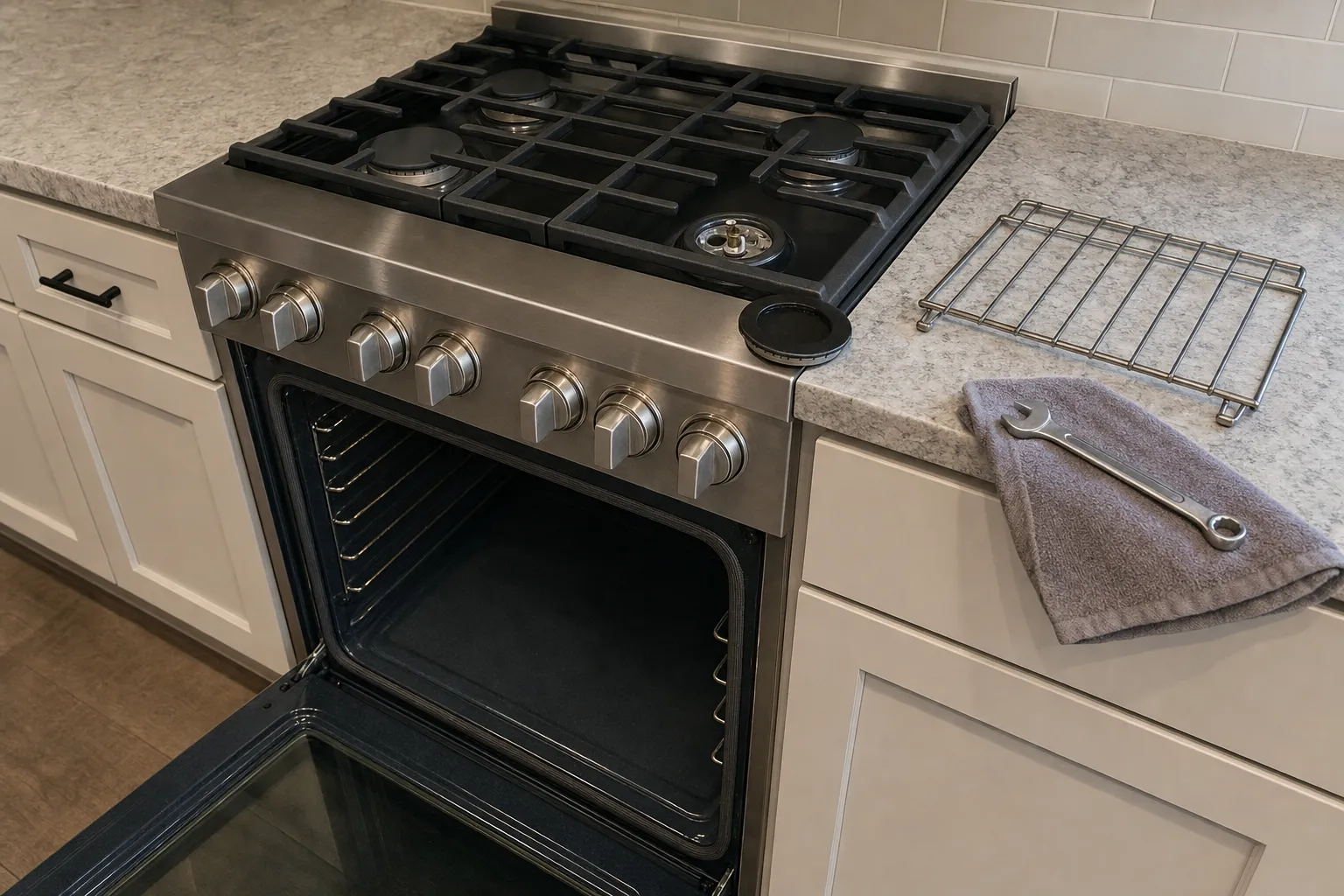
A front-left burner that clicks and clicks but never lights, while the others behave, is that burner’s own problem. Look at the cap seating first, then the ports, then the orifice. The spark is plainly working; what is missing is fuel arriving where the spark is.
A simmer burner that drops out as soon as the knob comes down is a low-fire adjustment or a partly restricted low-flame path. Every sealed burner has a minimum setting that has to be set correctly at the valve, and a burner that will not hold at the bottom of its range has either lost that setting or lost port area to deposit.
Yellow, sooty flames instead of blue are an air-to-gas mixture problem: incomplete combustion. The usual causes are an air shutter out of position, a venturi partly obstructed, or an orifice that does not match the gas the range is actually being supplied with — worth checking on any unit that has been moved or converted.
A griddle plate heating across only half its area is its own burner or element and its own thermostat. It says nothing about the condition of the range, and it is diagnosed separately.
Repair, or start again
Here is where the build-out decade stops being trivia. Owners who assume a replacement is like-for-like usually discover that the trim, the depth or the cutout is off by enough to need cabinet work, and cabinet work on a plateau kitchen tends to expose the next thing along: the neighbouring opening, the counter cut, the run of tile behind it.
Repair keeps the geometry you already have. That is a real asset when the opening was cut for a body nobody sells any more. An igniter or burner assembly, an oven thermostat or element, a control board: each has its own band on the price board of the range repair page, and the diagnostic visit is $89. Set against a replacement that drags cabinetry with it, that arithmetic favours repair further up the list than most owners expect.
The point at which it flips is structural: burner boxes corroded through, a chassis that has been modified to fit and no longer sits square, or a control platform with no parts route left. Those are worth naming honestly rather than patching twice.
What a diagnosis gives you
Sequencing. In a house where the range, the hood and the dishwasher were all installed in the same build year, you are not making one decision — you are making three, and the order matters. A diagnosis tells you which of them is genuinely at the end and which has another five years in it, so you can spend in the right order rather than replacing whatever failed first.
It also tells you, before a designer gets involved, whether the opening you have is one a current unit will actually sit in. That single answer has saved plateau owners more money than any part we fit.
If a burner will not light, a simmer setting will not hold, or the flames have turned yellow, call (425) 610-8986 or book through the link on this page. The model and serial number are the fastest way to get the right parts on the van.
Asked after this one
Will a new Viking range fit my 1990s Sammamish cabinet opening?
Not always without modification. Plateau kitchens were largely framed in the 1990s, before the city incorporated in 1999, to the built-in dimensions of that period. A 1990s 36-inch cooktop cutout, 27-inch wall-oven cabinet or 24-inch dishwasher opening frequently needs cabinet work to take a current body and its trim. Measure the opening and the depth before ordering, not after delivery.
Why are my Viking burner flames yellow instead of blue?
Yellow, sooty flames mean incomplete combustion: the burner is not getting the air-to-gas mixture it needs. The common causes are an air shutter knocked out of adjustment, a venturi partly blocked by debris or an insect nest, or an orifice that does not suit the gas being supplied, which shows up on units that have been converted or relocated. It is worth correcting promptly rather than cooking around.
Everything in my kitchen seems to be failing at once. Is that normal here?
It is ordinary on this plateau. Most of Sammamish was built out in one decade before the city incorporated in 1999, so whole kitchens were fitted within a few years of each other and their appliances reach the end of their lives together. Rather than react to each failure, get the survivors assessed and put them in order, so the spending follows condition instead of whichever unit happened to break first.